Pikey Peak Trekking 10 Days

Tour Info

Trip code

E-009

Starting Point/ End Point

kathmandu

Accommodations

Lodge/Tea House

Max Altitude

4,065 m

Duration

10 days

country

Trip grade

Moderate

Best Season

Spring (March–May) and Autumn (September–November)

Highlights

  • Witness a spectacular sunrise from Pikey Peak (4,065 m) with panoramic views of the Everest range and countless Himalayan giants.
  • Enjoy one of Nepal's best short trekking routes with fewer crowds than the classic Everest Base Camp trail.
  • Enjoy stunning vistas of Everest, Lhotse, Makalu, Kanchenjunga, Gaurishankar, Numbur Himal, Langtang, Ganesh Himal, and Manaslu.
  • Walk through the rhododendron forest, high altitude meadows, yak grazing land and undulating ridges of the Himalayas.
  • Discover the true Sherpa settlements of Jhapre and Junbesi with a lot of culture and mountaineering heritage.
  • Interact with Tibetan Buddhism in Thupten Chholing Monastery.
  • Marvel at ancient monasteries, fluttering prayer flags, mani walls and chortens along the route.
  • Receive hospitable treatment in traditional teahouses of the Himalayas during the trek.
  • Experience a gradual elevation gain, which ensures this trek is well-suited for moderate-fit individuals.
  • Take some fantastic mountain photos from one of Nepal’s best viewpoints.
  • Combine sightseeing in the culturally rich city of Kathmandu with a trek in a less frequented part of the Himalaya.
  • This trek is perfect for those who wish to see the panoramic view of the Everest region without doing the EBC trek.

Overview

The 10-day Pikey Peak trek is an adventurous trek that is not very difficult. It offers great views of the mountains, authentic Sherpa culture, and serene trail trekking in the lower Solukhumbu region/Lower Everest Region of Nepal. It is an adventurous trek recommended for those who wish to go on a less-traveled path while trekking in Nepal. 

From Kathmandu, the trek starts with some sightseeing tours in Kathmandu before traveling to Dhap via road and then following scenic trails passing through rhododendron forests, alpine meadows, yak grazing lands, and Sherpa settlements. The most enjoyable experience of your journey is the hike to the Pikey Peak, which is 4,065 meters above sea level, because on that day you will see the magnificent sunrise views of many Himalayan peaks, including Everest, Lhotse, Makalu, Kanchenjunga, Annapurna, Dhaulagiri, Manaslu, Langtang, Gaurishankar, and others. And after coming back from Pikey Peak, you can visit Thupten Chholing Monastery in Junbesi village.

Itinerary

Day 1: Arrival in Kathmandu (1,400 m) and Transfer to Hotel

After you arrive at Tribhuvan International Airport, our representative will welcome you and transfer you to your choice of hotel in Kathmandu using a private vehicle. You will get the opportunity to visit the beautiful city of Kathmandu, full of narrow streets, bustling bazaars, and old temples, through an aerial view. You can have an opportunity to experience the dynamic city of Kathmandu, provided that you arrive early in Kathmandu. Explore the surroundings of Kathmandu city or relish in its vibrancy.

  • Max Elevation: 1,400 m (Kathmandu)
  • Travel Distance: 5–10 km 
  • Travel Hours: 30–60 minutes
  • Accommodation: Hotel in Kathmandu
  • Meal: Dinner
Day 2: Sightseeing in Kathmandu and Trek Briefing

Today, your guide will brief you about the details of the trek. Then, you visit some of the most important cultural and spiritual sites in the Kathmandu Valley, and you get more insights about Nepal’s religion, history, and architecture.

Swayambhunath Stupa: The Swayambhunath Stupa is situated atop a hill overlooking the Kathmandu Valley. This is one of the most ancient sites of reverence in Nepal. Fluttering prayer flags, rotating prayer wheels, and playful monkeys around the stupa give it a sense of calmness as well as vibrancy.

Pashupatinath Temple: The most sacred Hindu temple of Nepal is the Pashupatinath, which is situated by the Bagmati River. This is a religious site where constant religious rituals take place.

Boudhanath Stupa: One of the largest Buddhist stupa in the world is the Boudhanath Stupa, and it is also a major tourist site of the Tibetan Buddhists as it has large mandalas, prayer wheels and crowds of devotees thronging it all the time.

Patan Durbar Square: Patan Durbar Square depicts the wonderful craftsmanship of the Kathmandu Valley.

  • Max Elevation: 1,400 m (Kathmandu Valley sites)
  • Travel Distance: 15–25 km (city sightseeing loop)
  • Travel Hours: 6–8 hours (full-day sightseeing)
  • Accommodation: Hotel in Kathmandu
  • Meal: Breakfast, Lunch Dinner


Day 3: Drive from Kathmandu to Dhap (2,850 m) – 8 to 9 Hours

On the third day, we begin your scenic drive to Dhap and the Pikey Peak Trek. The road winds its way through the countryside, passing lush green hills and terraced farms as well as dense forests and traditional villages. Further into the Solukhumbu region of the lower Mount Everest region, the terrain becomes more silent and hilly. Traversing beautiful valleys and villages, you will get to the location referred to as Dhap. From Dhap, you can witness the grand and stunning views of many beautiful peaks including the close and beautiful views of Numbur Himal and Lhotse, alongside the humbling grand Mount Everest. You will find yourself surrounded by the pure mountain air and the hilly regions at the beginning of your trek into the Himalayan mountains. Once you reach the destination, we take a short hike for the calming and humbling mountain views before we stop and rest for the night. 

  • Max Elevation: 2,850 m (Dhap)
  • Travel Distance: ~230–250 km
  • Travel Hours: 8–9 hours
  • Accommodation: Teahouse/Lodge in Dhap
  • Meal: Breakfast, Lunch, Dinner
Day 4: Trek from Dhap to Jhapre (2,920m) - 4 to 5 Hours

Your adventure today takes you through the meandering pastures and the pine forest. On this trail, you will be able to admire the view of the valley from the gently sloping hills. You will see many farm and village settlements that represent people living in the mountains of Nepal.

As we approach Jhapre, the multicolored prayer flags will greet you with their waving. This is the sign of the region's strong Buddhist tradition. Today, if the weather permits, you will be able to enjoy the views of Mount Everest, Lhotse, Numbur Himal, and other snowcapped peaks in the vicinity. If the weather is good, you can also witness the calming sunset view on this day. You can also visit an old traditional monastery which acts as a primary religious and cultural center for locals. Jhapre is an ideal place for your first destination.

  • Max Elevation: 2,920 m (Jhapre)
  • Travel Distance: ~7–10 km
  • Travel Hours: 4–5 hours
  • Accommodation: Teahouse in Jhapre
  • Meal: Breakfast, Lunch, Dinner
Day 5: Trek from Jhapre to Pikey Base Camp (3,640 m) – 5 to 6 Hours

The path takes you through forests of rhododendrons, juniper bushes, and alpine grasslands as you go up. The yaks can be found grazing in such areas during the warm season. The higher you go, the more the forest changes to a ridge from where you can see the Himalayas. The Pikey Base Camp is found below the summit. There are prayer flags flying around in the air as you near it. The peaceful place offers you the breathtaking views of the sunsets amidst the Himalayas, as well as giving you a chance to prepare for the summit trek the next day. The cool mountain air and clear night skies make your stay memorable during the trek.

  • Max Elevation: 3,640 m (Pikey Base Camp)
  • Travel Distance: ~9–12 km
  • Travel Hours: 5–6 hours
  • Accommodation: Teahouse/Camp near Base Camp
  • Meal: Breakfast, Lunch, Dinner
Day 6: Sunrise Hike to Pikey Peak (4,065 m) and Trek to Junbesi (2,800 m) – 6 to 7 Hours

Early in the morning, embark on a climb up to the summit of the stunning Pikey Peak, which offers one of the best views of nature in Nepal. At the time of the sunrise, you will be able to see an amazing view around you. With clear weather, the summit provides an amazing view of Everest, Lhotse, Makalu, Kanchenjunga, Numbur Himal, Gaurishankar, some parts of Rolwaling and Langtang mountains and other Himalayan peaks including far away view of Annapurna as well.
Having been at the summit for some time, go down through alpine areas, forests and ridges to reach the Sherpa village of Junbesi. You will have the chance to see some cultural features of the Solu area, like traditional villages, grazing grounds, centuries-old Buddhist stupas and more. Junbesi is known for its stone-made houses, friendly residents and nice mountain environment. It will be cold during the night, so don’t forget about warm clothes and enough water.

  • Max Elevation: 4,065 m (Pikey Peak)
  • Travel Distance: ~15–18 km (total descent trek)
  • Travel Hours: 7 - 8 hours
  • Accommodation: Teahouse in Junbesi
  • Meal: Breakfast, Lunch, Dinner
Day 7: Hike to Thupten Chholing Monastery and Explore Junbesi

From Junbesi, after your breakfast, you start your hiking journey to Thupten Chholing Monastery, which is the most significant Tibetan Buddhist monastery in the lower Everest region. Your route takes you through an easy ascent through pine forest, open hilltops, and Sherpa settlements. Along the route, enjoy peaceful mountain views as well as a spiritually uplifting hiking adventure.

Thupten Chholing Monastery is one of the monasteries which was founded by Tibetans in Nepal in the 1960s and led by the highly respected monk Trulsik Rinpoche. Currently, it serves as one of the major centers of Tibetan Buddhism in Nepal and houses a large number of monks and nuns who engage in meditation and studying. There is a vast area within the monastery which includes prayer halls, living quarters, prayer flags and chanting which often resounds throughout the valley, providing a very calm environment. 

Now, after having spent quality time inside the monastery learning about its traditions and interacting with the monks whenever possible, it is time for you to make your way back to Junbesi. At Junbesi, you get to spend some time exploring the Sherpa culture of the village, visiting some chortens and monasteries, or just resting in the serene environment of the mountains while you prepare for your overnight stay there.

  • Max Elevation: ~3,000–3,200 m (monastery hike)
  • Travel Distance: ~6–8 km (round trip)
  • Travel Hours: 4–6 hours (hike + exploration)
  • Accommodation: Teahouse in Junbesi
  • Meal: Breakfast, Lunch, Dinner
Day 8: Trek from Junbesi to Phaplu (2,400 m) –3 to 4 Hours

Moving away from Junbesi, the path descends through forest areas, farms, and villages, which will give you a first-hand view of the life of farmers in the region. Passing over rivers and off road trails, your journey finally comes to an end at Phaplu, which is a tranquil mountain village and acts as a gateway for the region of Mount Everest. Checking into your lodge, you can unwind or shop in the local markets. The journey for this day is rather short as we traverse through motorways. As a result, we can complete the entire journey for this day within 3 to 4 hours.

  • Max Elevation: 2,800 m (start point Junbesi)
  • Travel Distance: ~8–12 km
  • Travel Hours: 3–4 hours
  • Accommodation: Lodge in Phaplu
  • Meal: Breakfast, Lunch, Dinner
Day 9: Travel from Phaplu to Kathmandu – 9 to 10 Hours

On the ninth day of our journey, we get ready for the beginning of the scenic trip back to Kathmandu. This trip is characterized by the retracing of the winding trails of mountains through beautiful valleys, villages, forests, and agricultural terraces. After your arrival at Kathmandu, head to your hotel room and get some much-needed rest. You have free time this evening to spend in Thamel, buy souvenirs, visit cafés, or celebrate the end of your Pikey Peak Trek with your fellow trekking group members.

  • Max Elevation: 2,400 m (Phaplu)
  • Travel Distance: ~270–280 km
  • Travel Hours: 9–10 hours
  • Accommodation: Hotel in Kathmandu
  • Meal: Breakfast, Lunch, Dinner
Day 10: Final Departure

After breakfast, based on your time for the international flight, you will be transferred to Tribhuvan International Airport by a private car. It looks like your Himalayan adventure is about to end, and you are going to be leaving Nepal after creating great memories of the stunning Himalayan sunrise, serene trails, and Sherpa culture, among others.
We hope that your adventure inspires you to come back to Nepal some other time.

  • Max Elevation: 1,400 m (Kathmandu)
  • Travel Distance: 5–10 km approx.
  • Travel Hours: 30–60 minutes
  • Accommodation: None
  • Meal: Breakfast

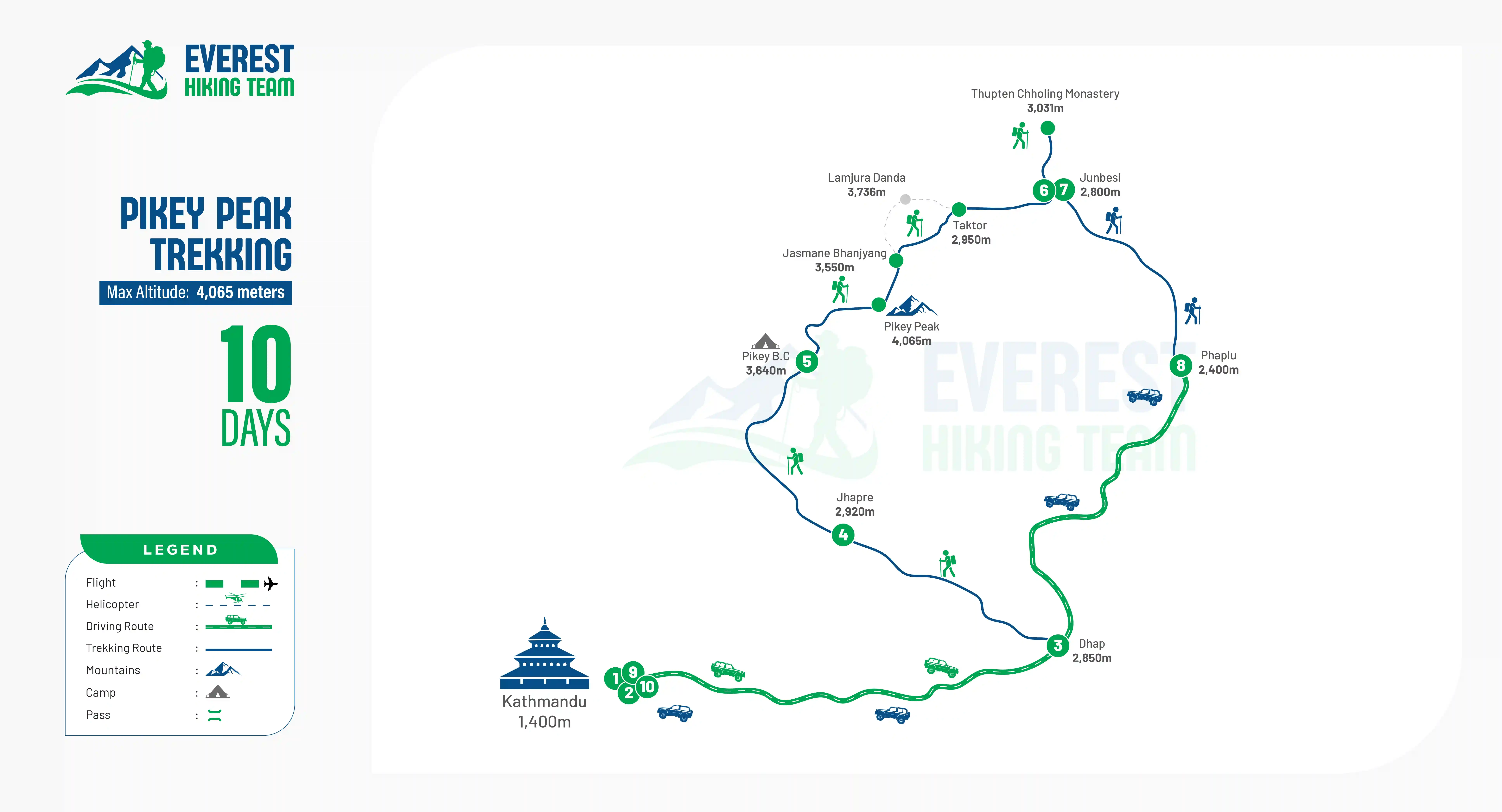
Trek Route

Pikey peak trekking 10 days

Packing List

Clothing

  • Moisture-wicking base layers (2-3 sets)
  • Warm fleece jackets or pullovers
  • Down jackets (essential in cold mornings and evenings)
  • Windproof and waterproof jacket
  • Trekking pants (2 pairs)
  • Thermal innerwear
  • Comfortable t-shirts with quick-drying
  • Warm hat/beanie, and sun hat/cap
  • Gloves (a light and warm pair)
  • Trekking socks (4-6 pairs)
  • Durable trekking boots (well-worn in)
  • Sandals or camp shoes for teahouses

Trekking Gear

  • Backpack (25 to 35L daypack).
  • Duffel bag (carried on the back by a porter, 70 to 90L)
  • Sleeping bag (rated from -10 °C up to -15 °C)
  • Trekking poles
  • Headlamp with Extra Batteries
  • Hydration bladders or water bottles

Personal Essentials

  • Sunscreen (SPF30+)
  • Lip Balm (SPF protection).
  • Personal hygiene kit: toothbrush, wipes, sanitizer, etc.
  • Quick-dry towel
  • Toilet tissue/toilet paper
  • Basic first-aid kit (bandages, painkillers and altitude medication if necessary)

Accessories and Extras

  • Sunglasses (UV protection)
  • Extra batteries / Power banks
  • Use a camera or phone to take photos
  • Snacks that are light (energy bars, chocolates, nuts)
  • Cash (Nepali Rupees) for small purchases
  • Passport + permits (copy and original)

What's included

  • Airport pick-up by private vehicle and drop-off at Kathmandu.
  • Hotel accommodation for 3 nights in Kathmandu (standard tourist category), including breakfast
  • Kathmandu sightseeing with a private vehicle and a professional guide
  • All necessary trekking permits (TIMS cards and local permits).
  • Ground Transportation: Kathmandu-Dhap (drive) and Phaplu-Kathmandu (drive), by shared/private vehicles as per itinerary
  • Accommodation in teahouses/lodges along the way (on a twin-sharing basis).
  • Three meals per day (breakfast, lunch, and dinner)
  • Experienced licensed trekking guides (English-speaking).
  • Number of porters required (1 porter per 2 trekkers; usually, they carry up to 25 kg).
  • Salary, insurance, meals and accommodation for guides and porters
  • The guide carries a first aid kit
  • Taxes and service charges by the government
  • Before departure, you will receive a detailed route map as well as a briefing.

What's excluded

  • Nepal international airfare
  • Nepal visa fee (payable upon arrival)
  • Lunch and dinner at Kathmandu, except for farewells or other specified inclusions
  • Travel insurance must cover emergency evacuation and high-altitude trekking.
  • Personal expenses (hot Showers, Wi-Fi at Teahouses, Charging Devices at Teahouses, Snacks, Drinks)
  • Soft drinks, alcohol beverages and bottled drinks
  • Personal trekking equipment (sleeping bag, down jacket, trekking poles, etc.)
  • Gratuities for guides and porters (expected, but not compulsory)
  • If required, emergency rescue or evacuation costs
  • Additional nights in Kathmandu if you return early, have a delay or change your flight.
  • Cost includes only the costs that are included in the cost

Frequently Asked Questions

How difficult is Pikey Peak Trekking?

This trekking trip in Nepal is known as the Pikey Peak Trek. It is known to be a moderate trekking route. One does not need any prior experience in climbing. It is advised that one is physically fit to walk up and down hills for about 4-7 hours per day. It would make your experience more fun if you had some hiking experience before. 

What is the maximum height of the trek?

Pikey Peak, at 4,065 metres above sea level, is the highest point on this trek. Do I need to have prior experience trekking?
This route is not for those with prior experience. This route is often recommended to beginners who want to experience the Himalayas without extreme altitude problems. You will be able to adjust better if you do some light walking or hiking before your trip.

When is the best time of year to hike this route?

Peak Trek is ideal during spring (March-May) or fall (September-November). This period is suitable for trekking as the weather is reliable and the sky is clear.

Can I see Mount Everest from Pikey Peak?

Pikey Peak is a great place to see Mount Everest, especially at sunrise. Everest, Makalu, Lhotse, Kanchenjunga and other Himalayan giants can be seen from Pikey Peak.

Is altitude sickness a major concern?

Altitude sickness is less common on this trek than on other higher routes, such as Everest Base Camp. Avoid rushing and stay hydrated.

What types of accommodation are provided?

There are simple teahouses run by the family members in the locality who reside on the route. Simple rooms with double beds and shared toilets are available. The atmosphere is friendly and warm after the long walk.

Are there Wi-Fi services and mobile network services?

Mobile network coverage is possible throughout various parts of the trail, but it may not work at certain places along the trail because of their remoteness and altitude. Teahouses have Wi-Fi access services; however, the quality of service is poor.

What is the availability of food on the trek?

Food provided by teahouses is healthy but basic. Food such as dal-bhat, rice meals, and eggs can be obtained here. Healthy food will give you the required energy to trek.

User Review